

- May 25, 2026
- Comments: (0)
Does your child look up at the night sky and ask questions you cannot answer? Questions about black holes, dark matter, whether life exists on other planets, and why the universe is still expanding?
If yes, you might be sitting across from a future astrophysicist. And if your next thought was, “But is that actually a career in India?” — this article is written specifically for you.
Careers in astrophysics in India are more real, more diverse, and more financially rewarding than most parents and students realise. This guide breaks it all down clearly: what astrophysics actually is, what the roadmap looks like from Class 10 onwards, what jobs are available, and how to get started.
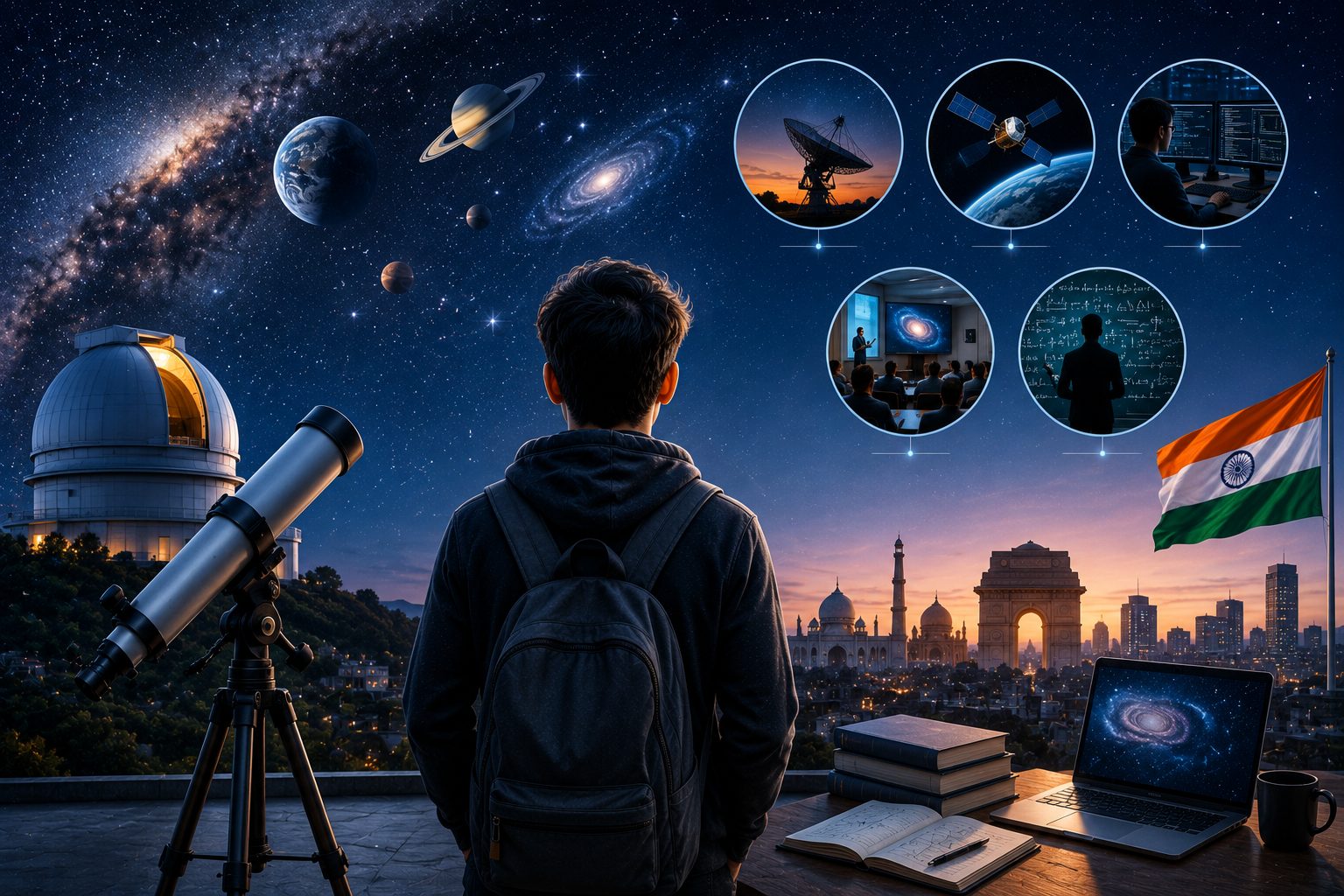
What is Astrophysics ?
Astrophysics is the branch of science that studies the physical nature of the universe — stars, galaxies, black holes, dark matter, and the Big Bang itself. But here is the part most people do not hear: modern astrophysicists spend a large part of their time writing code, building AI models, and working with massive datasets. It is as much a technology-driven career as it is a science one.
In India, the field has never been more relevant. After Chandrayaan-3’s historic Moon landing and the launch of Aditya-L1, India’s space ambitions are centre stage globally. The government has also opened the space sector to private players, and companies like Skyroot Aerospace and Agnikul Cosmos are hiring. This is no longer a field where you wait decades for one government job.
Why is astrophysics a serious career option ?
- India’s space economy is growing rapidly, targeting $44 billion by 2033, which means jobs across government agencies, research institutions, and private companies will continue expanding.
- Salaries are genuinely competitive. Astrophysicists and researchers in India earn between ₹15–25 LPA. Space scientists at ISRO earn ₹9–20 LPA. Data scientists working in astrophysics can earn ₹12–30 LPA.
- Career options go beyond research. Graduates become space scientists, data scientists, astronomers, planetary scientists, professors, and even astrophotographers.
- The skills travel well. Python, machine learning, statistical modelling, and data interpretation — skills that astrophysics graduates build naturally — are in high demand across finance, healthcare, and the technology sector too.
- It is a global career. Indian scientists regularly collaborate on international missions. Research done at IUCAA Pune can contribute to projects with NASA or ESA.
Careers and jobs in astrophysics in India
| Career | What you do | Salary in India | Salary abroad |
|---|---|---|---|
| Astrophysicist / Research Scientist | Study celestial bodies, develop theories, and conduct observations | ₹15–25 LPA | Up to $191,000 USD/year |
| Space Scientist at ISRO | Work on satellite missions, space exploration, and technology development | ₹9–20 LPA | $111,000–$183,000 at NASA/ESA |
| Astronomer | Observe celestial phenomena, write research papers, and build predictive models | ₹8–15 LPA | Up to $137,000 |
| Data Scientist in Astrophysics | Use AI and machine learning to process data from telescopes and space missions | ₹12–30 LPA | Up to $170,000 |
| Professor / Academic | Teach, research, and contribute to the academic community at universities | ₹8–18 LPA | Varies |
| Astrophotographer | Capture celestial events for research institutions and media | ₹5–12 LPA | $40,000–$80,000 |
Skills that matter in modern astrophysics
This is not just a field for students who love stargazing. Employers and research institutions increasingly look for a specific combination of skills.
- Programming: Python is the most widely used language in astrophysics research.
- Data analysis: Handling large datasets from telescopes and satellites is a daily task.
- Machine learning: AI applications in space science are growing rapidly.
- Mathematics and statistics: Strong fundamentals are non-negotiable.
- Communication: Research scientists write papers, present at conferences, and collaborate globally.
The good news is that these skills also make astrophysics graduates highly employable in sectors well beyond space science.
Key institutions and research centres in India
Students do not have to leave India to access world-class astrophysics research and education.
- ISRO — Indian Space Research Organisation, responsible for India’s space missions and one of the largest employers for space scientists.
- IUCAA Pune — Inter-University Centre for Astronomy and Astrophysics, a hub for astronomy research and internship opportunities.
- TIFR Mumbai — Tata Institute of Fundamental Research, offering research programmes from undergraduate level.
- IISc Bangalore — Top-ranked science university with strong physics and research departments.
- IISERs — Indian Institutes of Science Education and Research, offering integrated science programs with excellent research focus.
Download the Free Astrophysics Career Roadmap : Link
FAQ
1. What is the career scope of astrophysics in India?
Astrophysics in India offers careers as space scientists at ISRO, research scientists at TIFR and IUCAA, data scientists, astronomers, professors, and increasingly in private space companies. India’s space economy is targeting $44 billion by 2033, which means the demand for trained professionals will continue growing.
2. How do I start a career in astrophysics after Class 12 in India?
After Class 12 with PCM, students can apply for B.Sc. Physics or Astrophysics at institutions like IISc, IIST, TIFR, or IITs. The full path typically involves a B.Sc., M.Sc., and PhD, along with skills in Python and data analysis.
3. What is the salary of an astrophysicist in India?
Astrophysicists and research scientists in India typically earn between ₹15–25 LPA. Data scientists with an astrophysics background can earn ₹12–30 LPA. Space scientists at ISRO earn ₹9–20 LPA, with international positions at NASA and ESA earning significantly higher.
4. Is astrophysics a good career for Indian students?
Yes. The combination of analytical skills, programming, and scientific knowledge that astrophysics graduates develop is valued across research, technology, finance, and the private sector. It is one of the few science careers where skills transfer widely even outside the core field.
Not sure if Astrophysics is the right path ?
Expert career & study abroad counseling to guide you in making the right choice.