

- August 18, 2026
- Comments: (0)
If you’ve been exploring careers in artificial intelligence, you’ve probably come across two names again and again: Prompt Engineering vs AI Engineering.
At first glance, they can sound like two versions of the same career. Both involve artificial intelligence. Both work with tools such as large language models. And both are becoming part of the rapidly changing technology job market.
But there is an important difference.
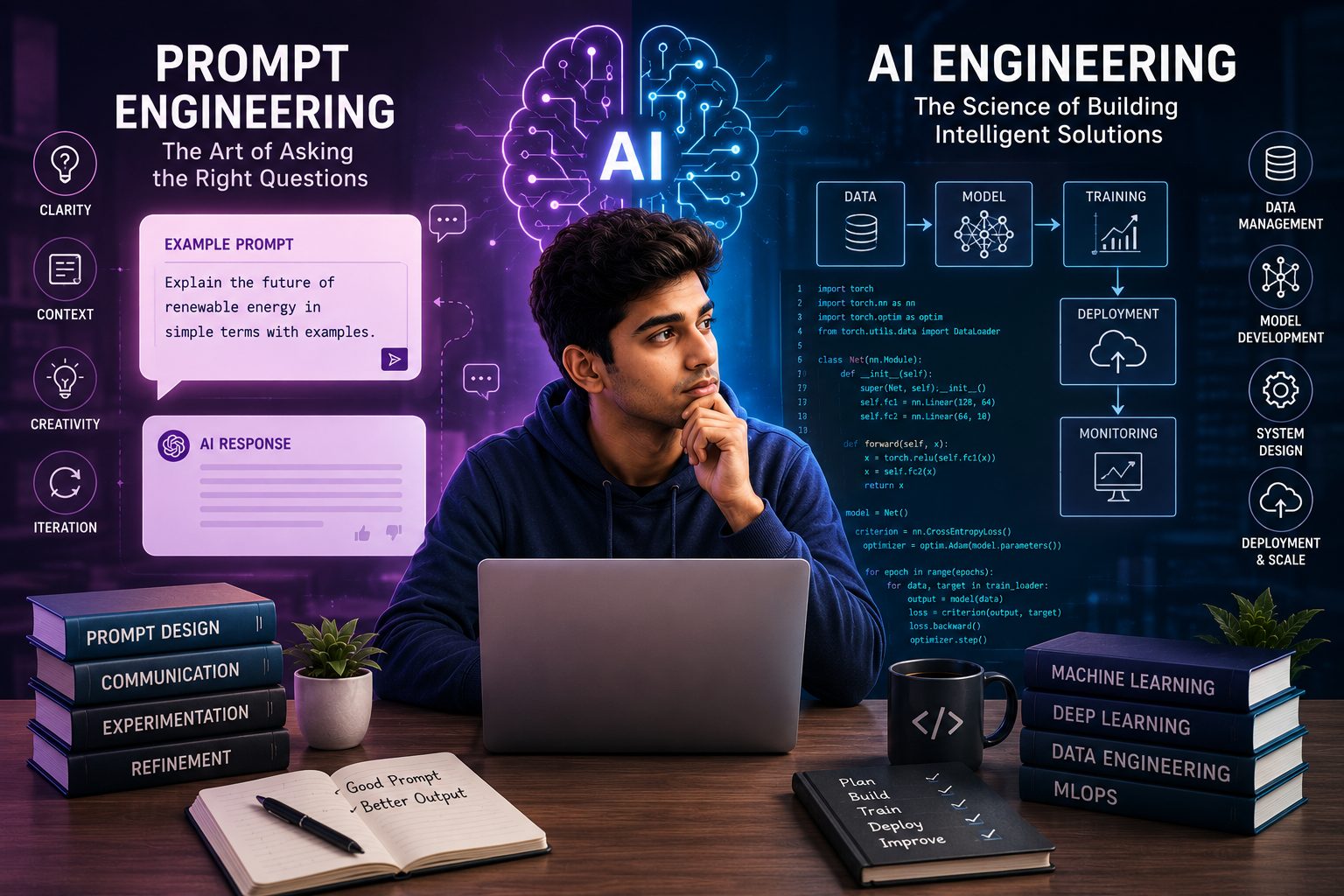
Prompt engineering is primarily about getting better results from AI systems. AI engineering is about building, integrating, testing, and deploying those systems.
That difference matters if you’re a student deciding what to study after Class 12, a graduate choosing a technology specialisation, or a professional thinking about switching into AI.
The good news is that you don’t necessarily have to choose between the two forever. Prompting can become an important skill within an AI engineering career. At the same time, AI engineers need to understand how to communicate effectively with AI models.
Why AI Careers Are Growing in 2026
Artificial intelligence is no longer limited to research laboratories or large technology companies.
Businesses are using AI for customer service, software development, marketing, finance, healthcare, cybersecurity, education, manufacturing and many other areas.
The World Economic Forum’s Future of Jobs Report 2025 identifies AI and big data as the fastest-growing skill area, while AI and machine learning specialists are among the fastest-growing technology roles through 2030.
This creates opportunities for students with different backgrounds.
You don’t necessarily need to become a hardcore programmer to work with AI.
But if you want to build AI products and systems, deeper technical skills become increasingly important.
That’s where the difference between prompt engineering and AI engineering becomes important.
What Is Prompt Engineering?
Prompt engineering is the process of designing and refining instructions that help AI models produce useful, accurate and consistent results.
Think about asking an AI tool:
“Write a blog about studying abroad.”
You may get a generic answer.
Now imagine giving it a much more structured instruction covering the target audience, tone, purpose, format, examples, limitations and desired outcome.
The quality of the output can improve significantly.
That is the basic idea behind prompt engineering.
However, prompt engineering in 2026 is becoming more than simply writing clever sentences.
Professionals increasingly use prompting alongside AI workflows, evaluation, context management, automation and AI agents. Recent industry coverage in India also suggests that standalone prompt-engineer positions are becoming less common, while prompting is increasingly being absorbed into broader AI and technology roles.
What Does a Prompt Engineer Work On?
Depending on the organisation, the work may involve:
- Designing prompts for AI applications
- Testing different prompts and outputs
- Improving AI-generated responses
- Creating structured AI workflows
- Developing evaluation criteria
- Working with LLM-based tools
- Building AI-assisted content or business processes
- Helping teams use generative AI effectively
Prompt engineering can therefore be useful across technology and non-technology industries.
What Is AI Engineering?
AI engineering is the broader technical discipline of building and deploying AI-powered applications and systems.
An AI engineer may work on:
- Machine learning models
- Generative AI applications
- Large language model integrations
- AI agents
- Recommendation systems
- Natural language processing
- Computer vision
- Retrieval-augmented generation (RAG)
- Model evaluation
- APIs and cloud deployment
In simple terms:
A prompt engineer helps an AI system respond better.
An AI engineer helps build the system around the AI.
This usually means AI engineering requires stronger programming and technical foundations.
Prompt Engineering vs AI Engineering
| Factor | Prompt Engineering | AI Engineering |
|---|---|---|
| Main Focus | Getting better outputs from AI | Building AI-powered systems |
| Coding Requirement | Low to moderate depending on role | Moderate to advanced |
| Mathematics | Usually limited | Important for many technical roles |
| Python | Helpful | Often essential |
| Machine Learning | Basic understanding can help | Strong understanding recommended |
| LLMs | Important | Very important |
| APIs | Useful | Important |
| Career Scope | Cross-industry AI skill | Dedicated technical AI career |
| Entry Barrier | Relatively lower | Higher |
| Long-Term Depth | Best as part of a broader skill set | Strong technical career path |
Career Opportunities in India
India’s AI ecosystem is expanding across startups, IT services, global capability centres, product companies, consulting firms and traditional businesses.
That creates opportunities in areas such as:
Prompt Engineering & Generative AI
Possible roles include:
- Prompt Engineer
- Generative AI Specialist
- AI Content Specialist
- AI Automation Specialist
- AI Solutions Consultant
- LLM Application Specialist
However, don’t search only for the exact title “Prompt Engineer.”
That’s one of the biggest mistakes students make.
Companies may include prompt engineering within roles such as AI Specialist, GenAI Consultant, AI Product Specialist, LLM Engineer, AI Automation Engineer or AI Solutions Engineer.
Recent Indian reporting highlights this transition: prompting is increasingly being treated as a capability within broader AI roles rather than a standalone job in every organisation.
AI Engineering
AI engineering offers a wider technical career ladder.
Potential roles include:
- AI Engineer
- Machine Learning Engineer
- Generative AI Engineer
- LLM Engineer
- NLP Engineer
- Computer Vision Engineer
- AI Solutions Engineer
- Machine Learning Developer
The World Economic Forum identifies AI and machine learning specialists among the fastest-growing jobs globally, reinforcing the longer-term demand for deeper AI capabilities.
Career Opportunities in Abroad
AI careers are not limited to India.
The USA, UK, Canada, Germany, Australia, Singapore, Ireland and several other technology hubs are investing heavily in AI applications and infrastructure.
International opportunities can be found in:
- Technology companies
- Financial services
- Healthcare
- Consulting
- Automotive
- E-commerce
- Cybersecurity
- Robotics
- Research
- SaaS companies
- AI startups
For students planning to study abroad, AI engineering can be particularly attractive because it combines software development, data, machine learning and AI systems.
Prompt engineering can also be valuable internationally, but students should be careful about treating it as a standalone qualification.
A better strategy is to develop prompting alongside another strong skill such as:
Programming + AI
Marketing + AI
Finance + AI
Design + AI
Data Analytics + AI
That combination can make your profile much more useful to employers.
Prompt Engineering Salary vs AI Engineering Salary
Salary depends heavily on experience, location, company, technical depth and the exact job title.
This is particularly important with prompt engineering because the title is not standardised across employers.
Indicative India Salary Range
For AI-focused roles, early-career salaries can vary considerably. Some 2026 Indian industry sources place AI engineering entry-level compensation around the ₹8–18 LPA range at product companies, while prompt/GenAI roles can span a broad range depending on technical responsibility and employer.
Rather than promising a fixed salary, students should think about the skill level behind the salary.
A candidate who only knows prompting will generally have fewer technical options than someone who can:
- Write Python
- Work with APIs
- Build an LLM application
- Use databases
- Understand RAG
- Evaluate AI outputs
- Deploy applications
- Debug production systems
Abroad
AI engineering salaries can be significantly higher in major international technology markets, particularly in the USA and other established technology hubs.
However, students should compare salary against tuition, living costs, taxes and visa conditions rather than looking at a headline salary alone.
For example, a ₹1 crore-equivalent salary abroad does not automatically mean better financial outcomes if the cost of studying and living is extremely high.
Unocue Tip: Think in terms of ROI, not just salary.
The Real Future of AI Careers
The biggest mistake students can make in 2026 is chasing a job title instead of building skills.
AI is changing too quickly for today’s exact job titles to remain unchanged for the next decade.
The World Economic Forum expects nearly 40% of workers’ existing skill sets to change or become outdated between 2025 and 2030, while AI and big data are projected to be among the fastest-growing skills.
That means adaptability matters.
Don’t just learn how to write prompts.
Learn how AI works.
Don’t just learn Python.
Learn how to solve problems.
Don’t just collect AI certificates.
Build projects.
And don’t choose a career simply because someone on social media says it pays ₹50 lakh.
Understand what employers actually need.
FAQs
Is prompt engineering a good career in 2026?
Yes, but students should avoid treating prompting as only a standalone job title. Prompting is increasingly becoming part of broader AI, product, automation and business roles.
Is AI engineering better than prompt engineering?
For students seeking a long-term technical career, AI engineering generally offers broader career options. Prompt engineering remains a useful complementary skill.
Can a commerce student learn prompt engineering?
Yes. Prompt engineering can be learned without a traditional computer science background. Commerce students can combine AI with finance, accounting, marketing or business.
Build Your AI Career With Right Direction
Expert career & study abroad counseling to guide you in making the right choice.